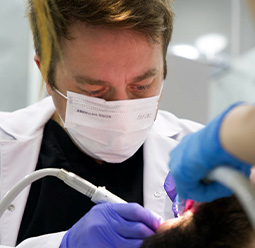
Conservative and Endodontic Treatments (Dental Fillings and Root
Canal Treatment in Children)
Dental health in children is crucial for both oral development
and overall health. Unhealthy eating habits, poor oral hygiene,
and neglecting regular dental checkups can lead to cavities
during childhood.
Initially felt only when eating, the pain can become spontaneous
and persistent over time. In such cases, early intervention is
necessary to protect the tooth. Depending on the extent of the
decay, a filling (conservative treatment) or root canal
treatment (endodontic treatment) may be necessary.
It is restored with filling material that will restore the
function of the tooth.
The chewing function of the teeth is preserved
Caries progression and sensitivity are prevented.
In Which Situations Are Fillings Made for Milk Teeth?
Change in breath odor
Darkening of tooth color
The child tries to express pain by touching his cheek
Chewing problems while eating
Bad breath
Asymmetrical facial expressions when speaking or laughing
What Happens If Baby Teeth Are Not Treated?
Infection and abscess may develop
The eruption path of permanent teeth may be disrupted
Jaw development may be negatively affected
Speech disorders and chewing problems may occur.
Rotten teeth can affect overall health and increase the risk
of rheumatic and heart diseases.
Root Canal Treatment (Endodontic Treatment)
If decay in primary teeth has progressed to the pulp (nerve
tissue) layer, root canal treatment may be necessary. Root canal
treatment is performed to protect a tooth damaged by decay,
trauma, or infection, maintain oral function, and ensure the
proper eruption of permanent teeth.
When is Root Canal Treatment Necessary in Children?
If there is a tooth abscess or inflammation
If the nerve tissue of the tooth is damaged
If the tooth is broken due to trauma
If tooth loss affects speech and eating functions
Pulp Treatment (Medicated Intervention)
It is applied in early caries where the pulp tissue is not
damaged.
Supported by anti-infective drugs
The tooth is protected and covered
Pulpotomy (Partial Root Canal Treatment)
Applies only if the infection is limited to the crown of the
tooth.
Healthy nerve tissue is preserved
With antibiotic-supported intervention, the tooth maintains
its function for a long time.
Pulpectomy (Full Root Canal Treatment)
Applied in advanced infections
All nerve tissue is cleaned, channels are shaped and filled.
It is ensured that the tooth remains in the mouth without
being pulled.